
Ultimate Self-guided Freedom Trail Tour: Explore Boston’s Revolutionary History Like a Local
Founder, CEO of See Reality and XR enthusiast
Boston’s Freedom Trail is more than a sightseeing route—it’s a walk through the birth of a nation. Stretching 2.5 miles and connecting 16 historic sites, this iconic path lets visitors step into the lives of the revolutionaries who shaped America’s history. Whether you’re a first-time visitor or a seasoned Bostonian, the Freedom Trail offers something new every time. With this guide I want to give you explanations to each stop along the trail, show pictures of what it looked like back in colonial times, and give helpful tips and recommendations.

My personal favorite way to make the self-guided tour a fun and immersive journey, is by combining it with the Relive 1776 AR experiences by See Reality. At key stops along the trail, you can witness history come back to life through cutting-edge technology. Explore the story of the American Revolution and Relive 1776 by experiencing the events that led to the American Revolution in chronological order, interact with important figures like Paul Revere and Samuel Adams, and even fire a historically accurate field cannon. It’s a fun, immersive way to learn about Boston’s history and America’s fight for independence. Another great thing about it: it can easily be combined with your self-guided tour to let you experience Boston at your own pace and without being stuck in a big tour group. The experiences can be easily pre-booked online on See Reality’s website or you can just walk up to the Relive 1776 stand in Boston Common. If you want to get more information about the different options to explore the Freedom Trail, check out my guide on Exploring the Freedom Trail like a Local.
Here’s my free self-guided Freedom trail tour that let’s you make the most of your journey in 2025:
Start at Boston Common
Begin your walk at Boston Common, America’s oldest public park. You can find the start of the trail right in front of the Boston Common Visitors Center, at the exit of the Park Street subway station. Take a moment to appreciate the green expanse where colonial militia once trained and locals now picnic. From here, you can follow the red-brick trail on the ground that winds through the city’s most iconic landmarks.

The trail first takes you past the Commodore John Barry Memorial and this is also where you’ll find the first Relive 1776 experience at the See Reality booth. Here, you can try their Revolutionary Runway experience completely for free. You can use your phone to try on digital colonial outfits and take photos—like a snap from 1770. At their booth they also have an animated pirate you can interact with. It’s a fun start to the day and a great way to engage kids or first-time visitors. I recommend continuing with the full Relive 1776 5-part experience and witness history come back to life right in front of you: the Sons of Liberty meeting under the gand elm tree, a British military encampment appearing where it once stood, and you can even step into the scenes and take part in history. At four different locations along the trail, you’ll experience Boston’s revolutionary history through interactive storytelling, complete with free souvenirs and historical mini-games.

Just look for the Relive 1776 booth in Boston Common to begin your journey travelling back in time.
Pro Tip: Early mornings and weekdays are the best times to beat the crowds. Grab a coffee from a nearby café to fuel your adventure.
Boston Common
Established in 1634, Boston Common is America’s oldest public park and served as a camp for British troops during the American Revolution. After being used as a cow pasture by the Puritan settlers, it has transformed over the centuries into a hub for recreation and public gatherings. Today, it hosts numerous events, from concerts to political rallies.

In its earlier days, Boston Common was actually right on the Charles River. If you look around now you might be surprised the Charles River is nowhere in sight. Take a look at this map from the 17th century:

Notice how the park ends with a water front? Well, it turns out that much of the city as we know it today was created from a landfill expansion, and that includes all of Back Bay.
If you look up the park towards the Massachusetts State House, you should see a slight incline. This was once a massive hill called Beacon Hill. Once the steam engine train was invented, much of this hill was dug up bit by bit and transferred to areas like Back Bay to create new land. Here’s what Beacon Hill used to look like:

Land was also brought in from nearby hills throughout Massachusetts to expand Boston. After the land was formed and buildings started being built on it, large wooden rods were stuck deep into the new land for stabilization, and the city occasionally has to pump water to these rods to this day to make sure they don’t dry out.
In the 18th century, a British campsite was also set up in Boston Common. One primary task of the soldiers in this time was to enforce the Townshend Acts, which placed levies on goods like tea, glass, and paper, and granted soldiers the power of Writs of Assistance. This granted them the right to search homes without a warrant, which angered the locals of Boston.
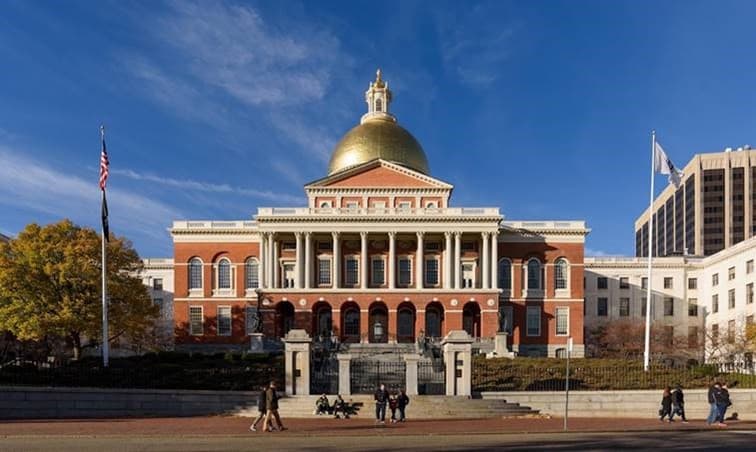
Massachusetts State House
Completed in 1798, the Massachusetts State House is the state capitol and the seat of government for the Commonwealth of Massachusetts. The building’s iconic golden dome was initially made of wood and later covered in copper by Paul Revere’s company in 1802 before being covered in gold. It remains a symbol of Boston’s rich history and political heritage.


Pro tip: if you don’t feel like hiking up the hill you can keep walking straight towards the Park Street Church. This way you can still take some nice pictures of the Capitol building from the bottom of the hill, save some energy for the day, and you will just reconnect with the Freedom trail at its next stop, right in front of the Church.
Park Street Church
Built in 1809, Park Street Church is renowned for its significant role in the abolitionist movement, including William Lloyd Garrison’s first anti-slavery speech in 1829. The church’s steeple was once the first landmark travelers saw when approaching Boston by sea. It continues to be an active place of worship and historical landmark.


Granary Burying Ground
Established in 1660, Granary Burying Ground is the final resting place of several notable figures, including Samuel Adams, John Hancock, and Paul Revere. Here you can see the graves of the famous Sons of Liberty that you got to meet in the first part of See Reality’s Relive 1776 experience. The burying ground’s name comes from a granary that was once adjacent to it. It remains one of the most visited historical sites in Boston, offering a glimpse into the city’s colonial past.
You will also find the tombstone for the victims of the Boston Massacre, and the young boy Christopher Snyder who was ruthlessly killed by a British statesman one week prior after a rock struck his wife through a window from an angry mob.
Over 5,000 people are buried here. In the back you might notice raised above ground tombs. Many of these tombs are actually staircases to underground crypts where many bodies were buried.
This was discovered by accident by a tourist in 2009 who accidentally fell down one of these staircases!


King's Chapel and Burying Ground
Founded in 1686, King’s Chapel was the first Anglican church in Boston and is renowned for its beautiful Georgian architecture. The chapel houses a bell made by Paul Revere that still rings today. The adjacent burying ground, dating back to 1630, is one of Boston’s oldest and includes the graves of notable colonial figures such as Massachusetts’ first governor, John Winthrop, the first woman off the Mayflower, Mary a Hilton, and the often forgotten William Dawes, who took off to Lexington with Paul Revere. The chapel and burying ground offer a glimpse into Boston’s early religious and civic life.


Benjamin Franklin Statue and Boston Latin School Site
The site of the oldest public school in America, founded in 1635, Boston Latin School educated many notable figures, including Benjamin Franklin. Although Franklin never graduated, his statue stands here in recognition of his contributions to American society. The site symbolizes the importance of education in the city’s history.


Old Corner Bookstore
Built in 1718, the Old Corner Bookstore became a significant literary center in the 19th century, frequented by authors like Charles Dickens and Harriet Beecher Stowe. Before its transformation into a bookstore, the building served as a pharmacy. It remains a beloved historical landmark, highlighting Boston’s literary heritage.


Old South Meeting House
Built in 1729, the Old South Meeting House is best known as the site where the Boston Tea Party was organized in 1773. The building was saved from demolition in 1876 by a group of 20 women who formed the Old South Association. It continues to serve as a museum and a reminder of Boston’s revolutionary spirit.
This meeting house is where Samuel Adams gave his speech to rile up the Boston Tea Party into throwing all of the tea from the East India Company overboard. They also met up here after the event to change into Native American costumes to escape undetected in the night.


The bottom picture was taken after the Great Boston Fire of 1872.
Old State House
Dating back to 1713, the Old State House was the seat of the Massachusetts General Court and the site of the Boston Massacre in 1770. The lion and unicorn statues on the building represent British rule but were removed during the Revolution and later restored. It now functions as a museum, offering insights into colonial and revolutionary Boston.


Boston Massacre Site
On March 5, 1770, British soldiers killed five civilian men at this site, an event that galvanized the anti-British sentiment leading to the American Revolution. Crispus Attucks, a man of African and Native American descent, was the first casualty, becoming an enduring symbol of the fight for freedom. The site is marked by a cobblestone circle, serving as a somber reminder of this pivotal moment in American history.
Just two weeks prior, a young boy named Christopher Snider (age 12) was killed by a British customs officer who fired his weapon out of the window of the Old State House at an angry crowd. This event sparked further outrage which led to the larger event remembered as the Boston Massacre (which the British referred to as ‘The Incident on King Street’).


Crispus Attucks was noticeably absent from Paul Revere's famous drawing of the event.
The captain also appears to be ordering his men to fire upon the Americans in this drawing, but that is an inaccurate portrayal. The captain did not order his men to fire, but one chose to and the rest followed suit.

At this stop of the Freedom Trail, See reality offers its next AR experience as a part of the Relive 1776 series. Here, the experience allows you to see this historic event come back to life in the exact spot it happened. By putting on a VR headset, you can immerse yourself and participate in this important historic event. Together with an angry mob of Americans you can provoke historically accurate British soldiers and they will react to you. To do the experience as part of your See Reality pass, you can just walk up to the Relive 1776 stand at the site or pre-book it on See Reality’s website.

Faneuil Hall and Quincy market
Known as the “Cradle of Liberty,” Faneuil Hall was built in 1742 and served as a marketplace and meeting hall. It was a key site for speeches by Samuel Adams and other revolutionaries who rallied support for independence. Today, it remains a vibrant marketplace and a symbol of American democracy.
Quincy market is a good place to take a lunch break. The different stands in the market offer all kinds of famous Bostonian foods like clam chowder or Lobster rolls and also international foods from around the world.


Paul Revere House
The Paul Revere House, built around 1680, is the oldest remaining structure in downtown Boston and was home to the famous patriot Paul Revere. Revere lived here with his family, which included 16 children, before his historic midnight ride in 1775. The house has been meticulously preserved and now operates as a museum, offering visitors a glimpse into colonial life and the personal history of Paul Revere. It provides an intimate look at the domestic life of one of America’s most celebrated historical figures.
See Reality’s Relive 1776 experience at the Paul Revere house allows you to see Paul Revere get on his horse to start his midnight ride where he says his famous phrase “the British are coming”. Book the immersive Relive 1776 experiences on See Reality’s website.


Despite Paul Revere being a man of modest fortune and little fame during his life (he became famous posthumously during to a popular poem by Henry Wadsworth Longfellow), this house was actually a bit of a mansion in its time. The owner before Paul Revere defaulted on their loan, and he was able to swoop in at a bargain price. The home actually has two kitchens, and is the only remaining home dating back to the 17th century in Boston. It’s actually the oldest building in general in Boston.
Old North Church
Built in 1723, Old North Church is Boston’s oldest surviving church building and the location from which the famous “One if by land, two if by sea” signal was sent. The steeple, the tallest in Boston, has been toppled twice by hurricanes. It remains an active Episcopal church and a historic site.


Copp’s Hill Burying Ground
Established in 1659, Copp’s Hill Burying Ground was the second cemetery in Boston and contains the graves of many notable Bostonians. British troops used the gravestones for target practice during the Siege of Boston. It offers a fascinating glimpse into the city’s early history and the Revolutionary War.
In this cemetery, bodies were once stacked as much as 6 people deep for those who wanted to save on expenses. Multiple people could share a tomb and have their names all etched onto the tombstones.


USS Constitution
Launched in 1797, “Old Ironsides” is the world’s oldest commissioned naval vessel still afloat. During the War of 1812, cannonballs were seen bouncing off its hull, earning it the nickname “Old Ironsides.” The ship is now a museum, celebrating its storied past and continued significance in American naval history.


Bunker Hill Monument
The 221-foot granite obelisk commemorates the Battle of Bunker Hill, fought on June 17, 1775, one of the first major battles of the American Revolution. While the British forces were victorious on this day, they sustained an alarming number of casualties despite their greater numbers. The monument stands as a testament to the bravery and sacrifice of the colonial forces.
Here you can fire a historicalIy acurate cannon from the 1700s to fight for America’s independence as the grand finale of the Relive 1776 experiences by See Reality. Get more information about the experiences, look for hours, and book the entire 5-part Relive1776 VIP tour on See Reality’s website.


Thanks for doing my self-guided tour and check out my Ultimate Guide to Exploring Boston in 2025 to get more insider tips on food, nightlife, museums, and many more things to do in and around Boston.